
The Complete Guide to Histopathology Instruments: Grossing, Microtomy, Processing, Automation & Digital Pathology (2025)
Diagnostics speed and accuracy hinge on three things: workflow design, equipment quality, and trained personnel. This guide walks procurement teams and lab directors through the complete list of instruments a modern histopathology lab should consider — from the first grossing table to the final coverslipper and digital whole slide scanner. Each section explains functional purpose, procurement checklist, performance indicators and how ISTOS Medical supports installation, training and AMC across India. Where helpful, product pages and technical assets are linked for quick reference.
- Grossing & related equipment — station sizes, formalin management, bone saws, cassette printers
- Cryostats — tabletop vs floor mounted and intraoperative needs
- Tissue processors — carousel, enclosed and fast processors
- Tissue embedding — embedding centers and workflow ergonomics
- Tissue sectioning equipment — manual, semi and fully automated microtomes, sliding microtomes, flotation baths & slide dryers
- Automated staining & coverslipping — linear, rotary and high throughput systems
- Digital pathology — whole slide imaging for telepathology and AI
- Solvent recyclers and sustainable lab operations
- Archiving systems — slide, block and specimen storage solutions
- Procurement checklist, ROI considerations and lead-capture strategy
- FAQ & maintenance best practices
1. Grossing & related equipment — first step, outsized impact
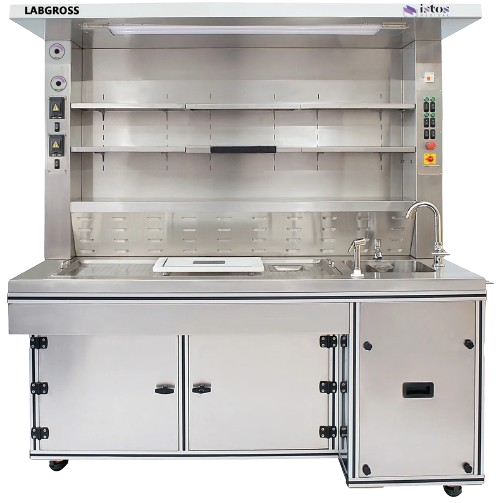
The grossing station is the first point of contact between the surgical specimen and your lab workflow. Proper grossing reduces mislabeling, prevents cross-contamination, standardizes tissue orientation and creates an audit trail that reviewers inspect closely. ISTOS provides modular grossing systems across multiple sizes (4.5 ft tabletop through 9 ft stations) with features suited to high-volume hospitals and teaching centers.
Core sub-items and procurement notes
- 4.5 Feet Table Top Grossing Station – compact units for diagnostic centers with limited footprint. Prioritize integrated lighting and a specimen tray with drainage channels.
- 5 / 6 / 8 / 9 Feet Grossing Stations – floor models for higher volume hospitals. Larger stations let two technicians work simultaneously, enabling parallel processing during peak theatre hours.
- Automated Formalin Preparation & Dispenser – automates formalin mixing and fill cycles for consistent fixation volumes and reduces manual handling exposure to vapors.
- Formalin Neutralizer – site safety requirement to treat formalin effluent and reduce VOC emissions in enclosed labs.
- Diamond Bone Band Saw – precise bone sectioning with dust suppression; critical for orthopedic pathology specimens.
- Automated 3-side Laser Cassette Printers – ensures durable labeling that survives downstream processing and archiving.
- Wax Dispenser & RDO Gold Decalcifying Solution – accessories that standardize embedding and decalcification steps, reducing rework.
- Material finish: non-porous, chemical-resistant (SS304 or coated composite)
- Lighting: shadow-free adjustable task lights with magnifier options
- Ventilation: local exhaust or fume-capture for formalin/volatile agents
- Integration: drawers or dedicated spaces for cassette printers and specimen photography
- Serviceability: access panels, OEM spare parts and on-site calibration
Why ISTOS Grossing Stations
ISTOS grossing solutions are tailored to Indian lab environments — corrosion-resistant finishes, modular lengths, and service contracts that include installation and SOP training. For product details and models, visit the ISTOS Grossing Station page.
2. Cryostats — rapid intraoperative diagnosis
Cryostats enable frozen sections with minimal downtime — essential for intraoperative margin assessments in oncology. Selection factors include freezing capacity, temperature stability, blade handling ergonomics, and safety features (UV decontamination, anti-freeze trays). ISTOS lists both full-sized cryostats and table-top models to suit OR-adjacent labs and satellite pathology units.
Tabletop vs. Floor Cryostat — tradeoffs
- Tabletop cryostats are compact, consume less space and suit low-volume ORs.
- Floor cryostats typically have larger chamber volumes, faster freeze rates and more robust compressors suitable for tertiary centers.
Procurement tip: Verify warranty on compressors and availability of quick-swap parts for field repairs — downtime during a surgical list can cost far more than equipment purchase price.
3. Tissue Processors — backbone of consistent histology
Tissue processors convert fixed tissue into paraffin-infiltrated blocks that withstand thin sectioning. For labs, reproducibility and closed-system safety are must-haves. ISTOS offers STP Carousel processors, enclosed processors, and fast processors that accelerate turnaround for urgent biopsies. The enclosed models limit exposure to xylene or clearing agents and are better for labs prioritizing operator safety.
Processor types explained
- STP Carousel Tissue Processors — batch architecture that cycles cassettes through reagent series (fixative → alcohols → clearing → paraffin). Good for predictable workloads and laboratories that process multiple similar case types.
- Enclosed Tissue Processors — minimize solvent exposure and are easier to integrate with exhaust and solvent-recycling systems.
- Enclosed Fast Tissue Processors — combine microwave or vacuum-assisted methods to speed infiltration for same-day reporting when necessary.
- Cycle programmability and memory for SOPs
- Reagent bottles and leak-proof piping
- Vacuum-assisted options and microwave acceleration for rapid processing
- Safety interlocks and enclosed exhaust
- Service & AMC coverage
Operational impact: Upgrading from manual to enclosed automated processors can reduce hands-on technician time, standardize block quality and reduce sample lost to poor infiltration — direct contributors to reduced re-cut rates and faster TAT.
4. Tissue Embedding — the orientation that enables accurate cutting
Embedding stations control wax temperature and orientation tools so tissues are correctly positioned for microtomy. ISTOS embedding centres are designed with multiple workstations, pre-warming features and contamination minimization to serve high-throughput labs. For small labs, a single embedding station with ergonomic layout can substantially reduce block rework.
Key embedding station features to evaluate
- Separate paraffin melting tanks and temperature controls
- Cold plate or chill blocks for faster wax setting
- Anti-static surfaces and dust management
- Accessory storage for molds and forceps
5. Tissue Sectioning equipment — where precision meets pathology
Sectioning quality directly affects staining uniformity and pathology interpretation. Microtomes (manual, semi-automated and fully automated), sliding microtomes for large specimens, flotation baths and slide dryers form the sectioning ecosystem. Reliable microtomes reduce chatter, preserve morphology and cut consistently at sub-5 µm thicknesses. ISTOS materials and microtome best-practice content are available for procurement teams and technicians.
Microtome types and when to choose them
- Manual Microtome — durable, lower cost, suited to labs with experienced technicians and low throughput.
- Semi-Automatic Microtome — motor-assist for feed but manual retraction; reduces fatigue and improves consistency for moderate workload labs.
- Fully Automated Microtome — programmable thickness settings, auto-retraction and waste handling for high throughput or centralized labs.
- Sliding Microtome — used for large blocks or research samples (whole organ sections).
- Automated Slide Labelers & Laser Slide Printers — automate slide ID and barcoding to eliminate human transcription errors.
- Tissue Floatation Bath & Slide Dryers — produce flat section ribbons and speed dry times before staining. See ISTOS’s flotation bath & dryer product page for features and compatibility.
- Thickness range (min and max µm) and calibration procedure
- Vibration and noise levels
- Blade change ergonomics and blade disposal
- Service intervals and spare blade availability
- Compatibility with cassette sizes and slide label workflows
Microtomy best practices (operational): Always use clean, sharp blades, maintain a stable mounting temperature for blocks, and schedule routine calibration. ISTOS provides technician training and tips on microtomy to lower artifact rates and re-cut frequency.
6. Automated Slide Stainers & Coverslippers — consistency at scale
Automated stainers standardize reagent exposure times and reduce technician variability. For hospitals and centralized labs, linear and rotary stainers, plus high-throughput stainers paired with automated coverslippers, accelerate processing and produce uniform H&E and special stain results across batches.
When to choose linear vs rotary stainers
- Linear stainers move slides sequentially through reagent baths and are simple to maintain.
- Rotary stainers can provide continuous flow and faster throughput for very large slide volumes.
- High-throughput systems integrate robotic loading, reagent sensing and automated coverslipping for labs with >2000 slides/day.
Procurement teams should ask for reagent consumption data per 1000 slides and per-slide reagent cost estimates — a major operating expense over time.
7. Digital Pathology — whole-slide imaging & telepathology
Digitization changes how pathology works: slides become sharable data, AI algorithms can pre-screen regions of interest, and remote reporting becomes feasible for distributed hospital networks. ISTOS lists whole-slide imaging scanners designed for clinical workflows, with calibration and colour fidelity features required by diagnostic labs. Digital pathology investments must consider image storage, LIMS integration, and regulatory compliance for clinical use.
Key considerations for digital pathology procurement
- Scan speed (slides/hour) and resolution (objective equivalence)
- Colour fidelity and image compression strategies
- LIMS / PACS integration and DICOM compatibility
- Data governance: storage, backup and patient privacy
Tip: Start with a pilot for one clinical use case (e.g., dermatopathology or prostate biopsies) to validate throughput, pathologist workflows and storage costs before wider rollout.
8. Solvent Recyclers — lower operating costs and safer labs
Automated xylene and alcohol recyclers recover solvents from processing steps, cutting purchasing costs and hazardous waste disposal fees. For enclosed processors and high-volume labs, solvent recycling is both economical and a sustainability measure that auditors appreciate.
Recycler performance criteria
- Recovery rate (%) per batch
- Purity levels for reuse in processing
- Cycle time and throughput matching lab volumes
- Maintenance and filter replacement intervals
9. Archiving Systems — slides, blocks and specimen storage
Long-term access to slides and blocks is a medico-legal requirement for many hospitals. ISTOS provides slide storage cabinets, block storage cabinets and specimen storage cabinets with controlled humidity and lockable security. Evaluate storage capacity, modular expansion, fire-resistance rating and indexing systems for retrieval efficiency.
Archiving best practices
- Implement a digital index (barcodes) mapped to LIMS
- Designate climate-controlled rooms for long-term blocks
- Schedule periodic audits and integrity checks
10. ISTOS Medical Private Limited supplies modular grossing stations and accessories to leading labs and hospitals across PAN India, with supply, installation and AMC support
Effective lab layout follows specimen flow: receipt → grossing → processing → embedding → sectioning → staining → coverslipping → scanning/archiving. Design stations to minimize cross-traffic, provide waste management points near grossing and processors, and allocate space for reagent preparation and service access. An optimized layout reduces specimen transit time and the chance of misplacement.
11. Procurement checklist, ROI and AMC strategy
When evaluating vendors, procurement should consider:
- Service coverage & average response time (SLA)
- Availability of spare parts and consumables in India
- Operator training & SOP documentation
- Warranty & AMC terms with defined preventive maintenance steps
- Total Cost of Ownership (TCO): equipment price, consumables, energy and service
ROI example (illustrative): Replacing manual staining and manual microtomy with automated alternatives and fast processors can reduce daily labour hours by one FTE in a mid-sized lab, reduce re-cuts by ~15–25% and shorten average TAT by 24–48 hours — improvements that directly translate into faster clinical decisions and revenue preservation.
Request a Free Lab Assessment & Quotation
13. Frequently Asked Questions
How often should microtomes be calibrated?
Calibration depends on workload. For high-volume labs, quarterly calibration is common; lower volume labs can schedule semi-annual calibration. Include blade-holder checks and thickness verification as part of preventive maintenance. ISTOS provides calibration during AMC visits.
What is the difference between enclosed and open tissue processors?
Enclosed processors limit exposure to volatile solvents and integrate exhaust systems; they are safer but slightly more expensive. Open processors may be used with adequate exhaust and PPE. Enclosed fast processors add microwave/vacuum acceleration for quicker infiltration.
Can ISTOS install complete lab setups across India?
Yes. ISTOS offers pan-India installation, operator training and AMC contracts. Reach out to sales for site assessment and turnkey quotations.
Contact ISTOS Medical — start your lab upgrade
If you are a procurement head, lab manager, or hospital administrator evaluating histopathology equipment, ISTOS can provide product demonstrations, on-site assessments and customized quotations for your institution. Use the form above, call or WhatsApp sales for immediate assistance.